





Relative humidity is a value we often hear about in weather reports. But did you know that this figure doesn’t just tell us how humid the air is? It also significantly affects our health, comfort, and various processes in daily life — from healthcare and material preservation to environmental control in factories and homes. For this reason, understanding “relative humidity” is more important than you might think. This article will introduce its meaning, measurement methods, and the potential effects of relative humidity levels in different situations.
What Is Relative Humidity?
Relative Humidity (RH) is the ratio between the actual absolute humidity present in the air at a given moment and the maximum absolute humidity the air can hold at the same temperature, expressed as a percentage. For example, RH = 50% means the air contains half the moisture it could hold at that temperature. If the air has RH = 100%, it means the air is fully saturated with water vapor and cannot hold any more moisture, which may lead to condensation into water droplets or rain.
Relative humidity is not only important for weather forecasting but also affects the body’s ability to dissipate heat. On very humid days, sweat evaporates slowly, causing a feeling of stuffiness and heat even when the temperature is not particularly high. Conversely, on dry days, we feel cooler because sweat evaporates easily, causing the skin temperature to drop quickly.
Furthermore, relative humidity directly affects moisture-sensitive materials such as wood, paper, fabric, and electronic devices. If the humidity is too high, materials may deteriorate or develop mold. If the humidity is too low, materials may dry out, crack, or become brittle. It is clear that RH is not a distant concept but is truly connected to the environment around us.
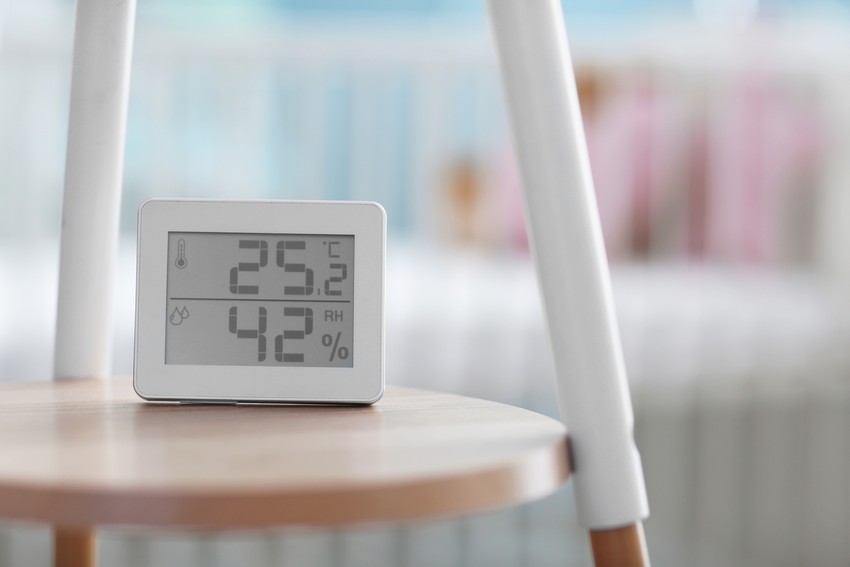
What Is Relative Humidity in the Air and How Is It Measured?
In daily life, we are constantly exposed to relative humidity in the air, whether we realize it or not. For example, rainy days often have RH close to 100%, making the air feel damp and sticky. Meanwhile, extremely hot but dry days (low RH) can cause nasal irritation or dry skin. Relative humidity therefore directly affects our comfort and health, including skin conditions, allergies, and the respiratory system.
Measuring relative humidity in the air has become easier today, thanks to devices such as hygrometers or digital humidity meters that can measure both RH and temperature simultaneously. These are suitable for controlling the environment in homes, factories, storage rooms, and even greenhouses — to maintain the quality of goods and the health of users.
RH measuring devices come in several types depending on their application, such as:
- Air humidity meter (Hygrometer)
- Portable relative humidity meter
- Material moisture meter – for wood, food, soil, etc.
Having these devices allows for better management of the indoor climate in homes or business establishments — in terms of health, safety, and maintaining the quality of materials used in daily life.
In addition, relative humidity plays an important role in many industries — such as the food industry, which must control humidity to preserve product freshness; the textile industry, where humidity affects fabric quality; and even in museums and archives that need to maintain the condition of documents and artifacts. Knowing and understanding how to manage RH is therefore a key to preserving the quality of both goods and facilities in the long run.
What Is the Ideal Relative Humidity Level?
The ideal relative humidity level for the human body and for living in enclosed spaces such as homes, buildings, or offices is between 40%–60% RH. If it falls below this range, it can cause dry skin, nasal irritation, or discomfort. If it exceeds 70%, mold, bacteria, or a clammy feeling may develop.
The appropriate RH control varies depending on the context, for example:
- Hospitals: 45%–60%, to prevent pathogen accumulation and maintain comfort.
- Server rooms or electronic equipment areas: 45%–55%, to prevent static electricity and circuit damage.
- Greenhouses: RH levels must be controlled according to the type of plant, generally ranging from 50%–80%.
An example of using the formula to calculate RH in an environment: if the actual water vapor density is measured at 10 g/m³ and the maximum saturation density is 17.3 g/m³ at a temperature of 20°C, the calculation would be RH = (10 ÷ 17.3) × 100 = 57.8% RH.

What Is the Relative Humidity Formula and How to Calculate It?
The formula for calculating relative humidity is: RH = (Actual Water Vapor Density / Saturated Water Vapor Density) × 100%
The unit for water vapor density is typically grams per cubic meter (g/m³), and the saturated water vapor density depends on the air temperature. For example, at 20°C, the saturation value is approximately 17.3 g/m³.
Calculation Example:
- Measured water vapor in the air = 12 g/m³
- Saturation value at 25°C = 23.1 g/m³
- RH = (12 ÷ 23.1) × 100 = 51.9%
Understanding this formula allows for effective application in industry, agriculture, and various research fields — especially for controlling the climate within rooms or specialized facilities.
“Relative Humidity” (RH) is the ratio between the actual amount of water vapor in the air and the maximum amount the air can hold at a given temperature. It has significant effects on daily life, including health, temperature regulation, living comfort, and material care. This article has also recommended the ideal humidity levels for different situations and provided the formula along with RH calculation examples for clear, practical understanding.
Whether you need to control humidity in your home, warehouse, factory, or office, DryerD is the partner you can trust. With high-quality dehumidifiers and humidifiers designed to meet the needs of every situation, you can manage humidity with precision and efficiency.
☎️ Tel: 02-906-7988, 02-033-5165
🟢 Line: @Dryer-D
📬 Email: dryer.dservice@gmail.com
📘 Facebook: เครื่องลดความชื้นและเครื่องเพิ่มความชื้น


